
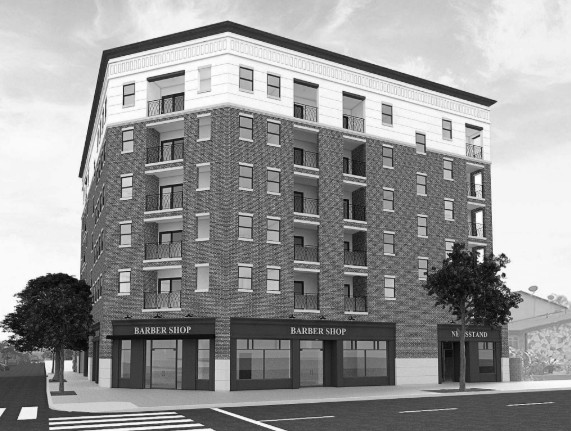
MEP Engineering for 1205 South Alvarado Efficient Mixed-Use Development
Project Overview
MEP Engineering for the 1205 South Alvarado Bldg supports a ground-up mixed-use development located in Los Angeles, California. The project consists of a new low-rise commercial and residential building designed to accommodate both living and business functions within a single integrated structure. The development reflects the growing demand for efficient urban infill projects that combine residential occupancy with flexible commercial opportunities.
The building configuration includes two levels of subterranean parking and six levels of above-grade construction dedicated to future commercial and residential spaces. The ground floor is planned as a commercial shell space with provisions for future tenant improvement, while the upper levels are allocated for residential use with full interior build-out included in the design scope. This dual-use program required a coordinated MEP engineering approach that supports varying occupancy types, load profiles, and operational requirements.
The overall design intent emphasizes system efficiency, constructability, and long-term adaptability. Special consideration was given to ensuring that base building systems can support future commercial tenants without major infrastructure modifications, while also delivering reliable and efficient services for residential occupants. The project aligns with typical urban mixed-use development strategies where flexibility and system integration are critical to long-term value.
Project Scope
The MEP engineering scope for the 1205 South Alvarado Bldg includes full mechanical, electrical, and plumbing design for a ground-up mixed-use development. The scope addresses both core and shell systems as well as interior build-out for residential areas, with dedicated provisions for future commercial tenant improvement at the ground level. This approach ensures that the building can accommodate future tenant needs without requiring major redesign or system upgrades.
Mechanical scope includes HVAC design tailored to support both residential comfort and future commercial flexibility. Residential systems are designed to provide consistent thermal comfort and energy efficiency across multiple levels, while the ground floor commercial space is planned with adaptable infrastructure to support varying tenant demands. Ventilation strategies, equipment placement, and system zoning were carefully coordinated to align with the building layout and structural constraints.
Electrical design includes power distribution for residential units, common areas, and base building systems, along with infrastructure provisions for future commercial tenant loads. The design considers load diversity between residential and commercial uses, allowing for efficient electrical system sizing while maintaining flexibility. Lighting systems, panel distribution, and routing were coordinated to support both immediate occupancy and future tenant build-outs.
Plumbing design addresses domestic water, sanitary, and drainage systems serving both residential units and commercial spaces. The design integrates vertical distribution strategies that align with building stacking and optimize routing efficiency. Special consideration was given to coordinating plumbing risers with structural and architectural layouts to minimize conflicts and support efficient installation during construction.
The project also required careful integration of MEP systems across multiple levels, including two subterranean parking floors and six above-grade levels. Routing of major systems, including ductwork, piping, and electrical conduits, was coordinated to maintain ceiling heights and usable space while ensuring accessibility for maintenance. The design approach prioritizes constructability by aligning system layouts with structural framing and minimizing field conflicts.
In addition, the MEP engineering design supports long-term performance and operational flexibility. By incorporating provisions for future tenant improvement and ensuring that base building systems can accommodate changing use conditions, the project is positioned to adapt to evolving market demands. This forward-looking approach reduces the likelihood of costly modifications and supports efficient building operation over time.
Services
Highligths
MEP Engineering Highlights
- Full MEP engineering design for ground-up mixed-use development with residential and commercial components
- Coordinated HVAC design supporting residential comfort and adaptable commercial tenant requirements
- Electrical design with flexible infrastructure for future tenant improvement at ground level
- Plumbing design integrated with vertical building systems for efficient multi-level distribution
- Two-level subterranean parking coordinated with above-grade MEP system routing
- Core and shell systems designed to support long-term flexibility and phased tenant occupancy
- Integrated MEP engineering approach aligned with architectural and structural design for constructability
Explore more of our MEP engineering projects in Los Angeles. Internal Link