
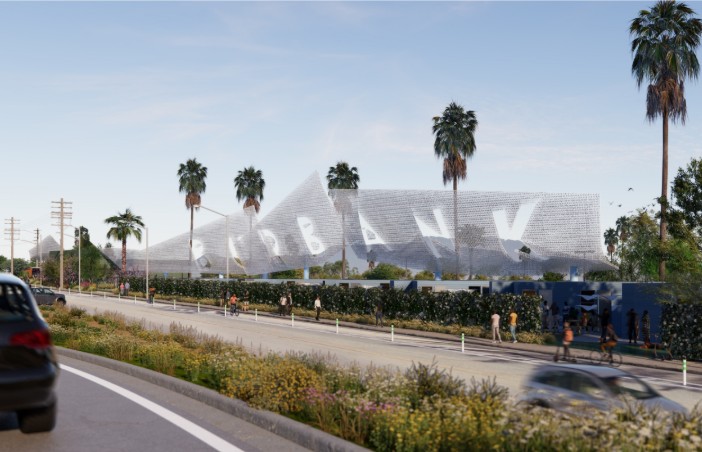
Burbank Homeless Center – 333 Front Street
Project Overview
MEP engineering for architects on a modular homeless services facility—adaptive reuse, phased permits, and site coordination in Burbank.
MEP Engineering for Architects: Burbank Homeless Center – 333 Front Street
Civic housing projects demand a careful balance of speed, coordination, and long-term reliability—often within tight budgets and complex regulatory frameworks. Architects leading these efforts need an MEP consultant who understands how modular construction, adaptive reuse, and phased delivery intersect at both the building and site scale.
For the Burbank Homeless Center at 333 Front Street, our team provided mechanical, electrical, and plumbing engineering to support the transformation of an existing retail building into administrative space, along with the installation of modular housing units for unhoused residents. The work was intentionally structured into two coordinated project scopes, allowing phased approvals and construction while maintaining consistent MEP strategy across the site.
This project reflects our role as a collaborative design partner, supporting architect-led civic housing projects with clear documentation, realistic assumptions, and permit-ready MEP design.
Project Scope
How We Support Architects
Phased, Multi-Scope MEP Coordination
The project was divided into two parallel efforts to support funding, permitting, and construction sequencing:
- Project #1: Interior tenant improvement and modular Connect Homes with ensuite restrooms
- Project #2: Safe Parking infrastructure
We coordinated MEP systems across both scopes to ensure consistent assumptions, service strategies, and documentation—while allowing each package to move forward independently.
Integrating Modular Housing with Site Infrastructure
Modular housing introduces unique coordination challenges at the site and utility level. We supported the architectural team by:
- Designing a new electrical service and main switchboard dedicated to the modular Connect Homes
- Coordinating utility routing (overhead or underground) across the site
- Aligning exterior power, lighting, and egress systems with site planning and safety requirements
- Clearly defining coordination boundaries between building, site, and civil scopes
Our MEP coordination approach prioritized clarity to reduce RFIs and avoid scope gaps during construction.
Our MEP Design Approach
Electrical: Site-Wide Clarity and Safety
Electrical engineering addressed both new and existing infrastructure, including:
- New utility service and power distribution to modular housing units
- Exterior site, pathway, and area lighting with Title 24–compliant controls
- Emergency egress lighting and photometric calculations for plan check
- Interior lighting, controls, and power distribution for renovated administrative spaces
Fire alarm systems were delivered as design-build, with responsibilities clearly defined to protect schedule and coordination.
Mechanical: Targeted Upgrades with Practical Reuse
For the interior tenant improvement, our mechanical electrical plumbing engineering scope focused on efficiency and realism:
- Evaluation and selective reuse of existing HVAC equipment
- New duct distribution coordinated with revised layouts
- Targeted exhaust additions where required by code
- Cooling provisions for low-voltage and equipment spaces
No HVAC systems were required for the modular housing units, allowing scope and budget to remain focused where most impactful.
Plumbing: Modular and Building Systems Aligned
Plumbing design addressed two distinct conditions:
- Utility distribution and connections to modular homes with ensuite restrooms
- Modifications and upgrades to existing building plumbing systems
- Riser diagrams, fixture calculations, and clear connection points coordinated with civil design
Interfaces between building and site utilities were clearly documented to minimize construction ambiguity.
Services
Highligths
Why Architects Choose Us as Their MEP Consultant
Architects partner with us on civic and housing projects because we understand the layered complexity these projects bring.
- Architect–Engineer Collaboration: Clear communication across phased and parallel scopes
- Civic & Housing Experience: Familiarity with public-sector review and modular construction
- Permit-Ready Documentation: Drawings aligned with AHJ expectations
- Risk Reduction: Early identification of infrastructure constraints and reuse strategies
We act as a trusted MEP consultant, helping architects deliver technically sound solutions for socially impactful projects.
Project Types We Support
This project reflects our broader experience providing MEP engineering for architects on:
- Homeless services and supportive housing facilities
- Modular and temporary housing installations
- Civic and municipal renovations
- Adaptive reuse of commercial buildings
- Phased, multi-package public projects
Across all project types, our focus remains the same: coordinated, constructable, and permit-ready MEP design.
Let’s Collaborate
If you’re looking for an MEP consultant who understands the realities of civic housing projects—phasing, modular coordination, and complex permitting—we’d welcome the opportunity to collaborate.
From early feasibility through permitting and construction coordination, we support architects with thoughtful MEP solutions that reduce risk and support meaningful outcomes.
Let’s talk about your next civic or community-focused project.